
St. Clair County Arrest News
Start with the Belleville News-Democrat Crime section. It is the strongest local outlet for the county and the wider Metro East, reporting on arrests, crime, and court matters as events unfold. Its blotter-style pieces draw on police reports and court clerks, so a story usually names the agency involved. Sheriff Richard Watson's office sits at the center of county enforcement, and its site covers the St. Clair County Sheriff's Department, the jail and Corrections system, and the route for requesting records.
Two smaller outlets round out the picture. Metro East Star publishes selected county incidents and agency announcements, giving place, charge, and case context, though it is no booking roster. RiverBender brings regional Metro East coverage, including the State's Attorney and East St. Louis, and runs a correction process on its stories.
Official records fill the gaps news leaves open. The Sheriff's Monthly Crime Calls archive tracks county activity month by month, and Belleville's blotter archive offers a weekly city window. Neither lists people or booking photos one by one. O'Fallon and Cahokia Heights had no verified public arrest log on their city pages.
Each source has its own job. News gives you the event and why it matters. The roster answers a custody question at a specific time. The court file holds the outcome, and no story can substitute for it. Keeping those roles straight keeps an old article from being mistaken for current status.
St. Clair News Outlets
Each outlet publishes differently, and each stops somewhere. The map below marks both. A photo in a story may come from an agency, a prior record, or the single case being covered.
| Outlet or source | Coverage | Photos? | Where it fits |
|---|---|---|---|
| Belleville News-Democrat | Local crime, arrest, court, and blotter reporting. | Story-specific agency or archival photos may appear. | Crime section, event-driven cadence. |
| Metro East Star | Selected St. Clair and Metro East incidents and releases. | Images may be agency-released or story-specific. | St. Clair report, no roster cadence. |
| RiverBender | Regional crime and State’s Attorney context. | Story images, not a county feed. | Regional reporting. |
| Belleville police blotter | Weekly calls for service with event and location fields. | No verified booking-photo roster. | City archive, not a booking log. |
| St. Clair Sheriff | Monthly calls and official department notices. | No verified county photo feed. | Official department. |
| Busted Newspaper | County-local secondary booking index. | Individual publisher pages may display a photo. | Unofficial county section, source and freshness need checking. |
| Mugshots.com | Secondary county record index. | Photos may appear with older records. | Unofficial county section. |
| Arrests.org | Dated publisher pages with filters and charge fields. | Photos may appear on detail pages. | Unofficial county page, not custody proof. |
| RecentlyBooked and Mugshots.zone | No verified Illinois St. Clair page found. | Do not infer coverage from another state. | Illinois index absent; Alabama St. Clair page is wrong state. |
Third-party pages are publisher indexes. No county agency stands behind them. A dated page can linger long after a person has left the jail, and a city filter can miss cases entirely. For custody status and outcomes, the original agency and the Circuit Clerk still come first.
The city-specific capture below shows the gap between crime statistics and a person-level booking record. It belongs here, beside that explanation. It does not belong in a photo gallery.
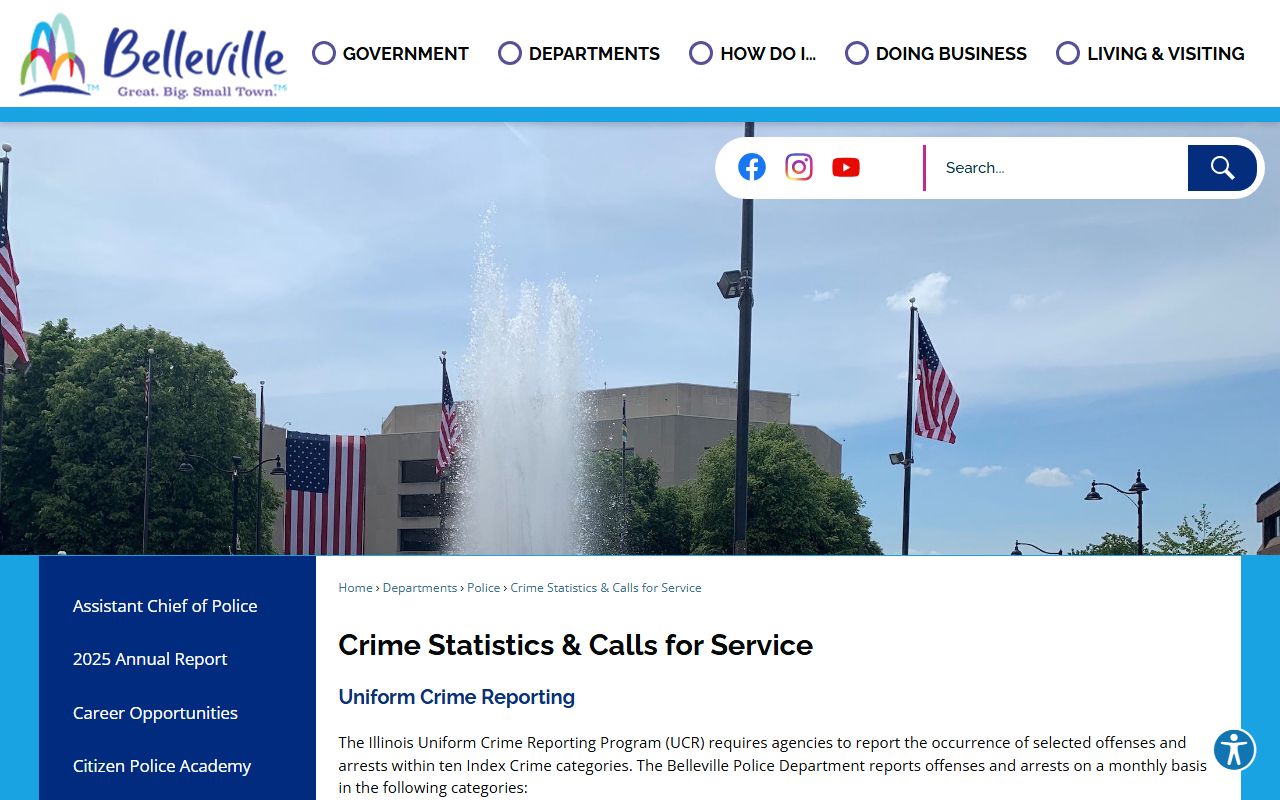
Belleville's archive is good for one thing: proving a window of local incidents exists. A calls-for-service entry, though, may reflect a traffic stop, a welfare check, or an investigation rather than any arrest at all.
How St. Clair Photos Reach News
How does a booking photo end up in the paper? A newsroom may get one from the arresting agency, pull it through a public-records request, lift it from an announcement, or reuse an older story. No single county policy turns every mugshot into a news release. BND stories can carry agency-supplied or archival booking images, while Metro East Star and RiverBender lean toward event-specific photos and reports.
Illinois law shapes the difference. 5 ILCS 140/2.15 treats a photograph as available arrest information, but only within limits tied to proceedings, safety, sources, and facilities. State law also bars law-enforcement social accounts from posting booking photos for certain lower-level offenses, with exceptions. So a newspaper story and a direct agency request can produce different results.
A photo in print proves nothing about custody. Someone may have been released before the story ran. The image may even date from years back. Flip it around, and a person missing from today's roster can still have an open court case or an old booking record on file.
Note: A photo’s presence in a story shows what the outlet published, not that the image is current, complete, or a final court record.
From St. Clair News to Record
A story is a lead, not an endpoint. Pull the agency, date, place, and case language from it, then chase the original record. For county custody, check the story against the official St. Clair inmate search. For the court path, go to the Circuit Clerk. A charge in print is a charge in print, nothing more.
- Save the story URL, publication date, named agency, arrest date, city, and case or incident number if the story gives one.
- Check the county-linked current-inmate roster when the question is whether the person appears to be in St. Clair County custody now.
- If the person is not listed, ask the Sheriff or arresting city police department for the historical record through the applicable records request.
- Search the St. Clair Circuit Clerk for the case, court dates, and later documents. Confirm identity with more than a name.
- Read the final disposition and any correction, sealing, or expungement order before repeating the original charge.
Want the wider picture? The county-wide St. Clair custody and booking-record path walks through the roster, the FOIA request, the state DOC handoff, and the federal and immigration lines. A news item should point back to those boundaries. It should not stand in for them.
A news story reports an event. The court disposition is where the real outcome lives. Charges can shift as a case moves through the system.
One caution from the Circuit Clerk: dates slip. Cases get continued or reset all the time, so a date in an old article may be stale. Some files are sealed, impounded, or restricted. If a record can't be viewed, say so plainly instead of plugging the gap with a publisher index.
Secondary St. Clair Indexes
Three third-party sites cover St. Clair County arrest material: Busted Newspaper, Mugshots.com, and Arrests.org. None of them speaks for the county. They are not the Sheriff, the jail, local police, or the courts, so treat them as private indexes rather than official sources. RecentlyBooked's Illinois section skips St. Clair entirely, and its Illinois path returns a 410 error. Mugshots.zone has a St. Clair page too, but it belongs to Alabama, not Illinois.
The Mugshots.com section shown below covers the Illinois county. Publisher pages there can carry a booking date, physical details, charges, and a photo. Just remember these fields come from the publisher, and they may be incomplete or stale.
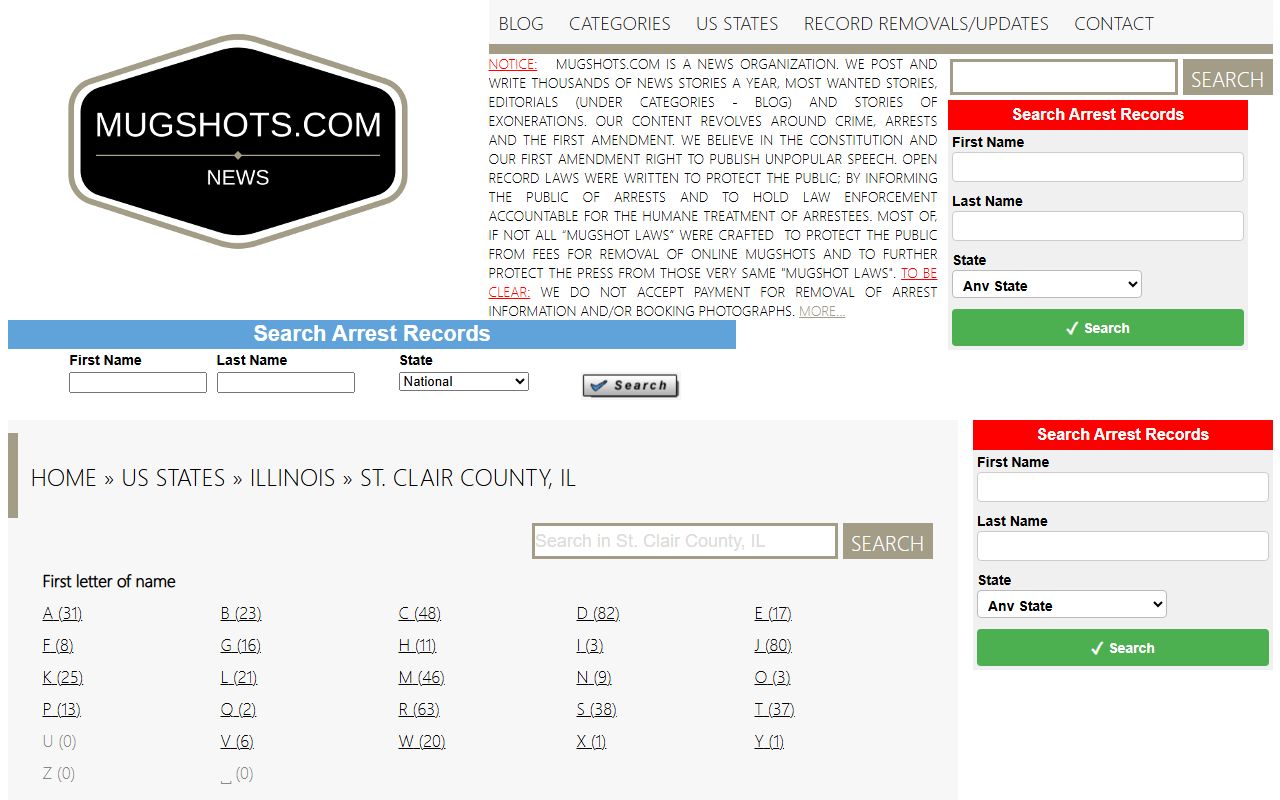
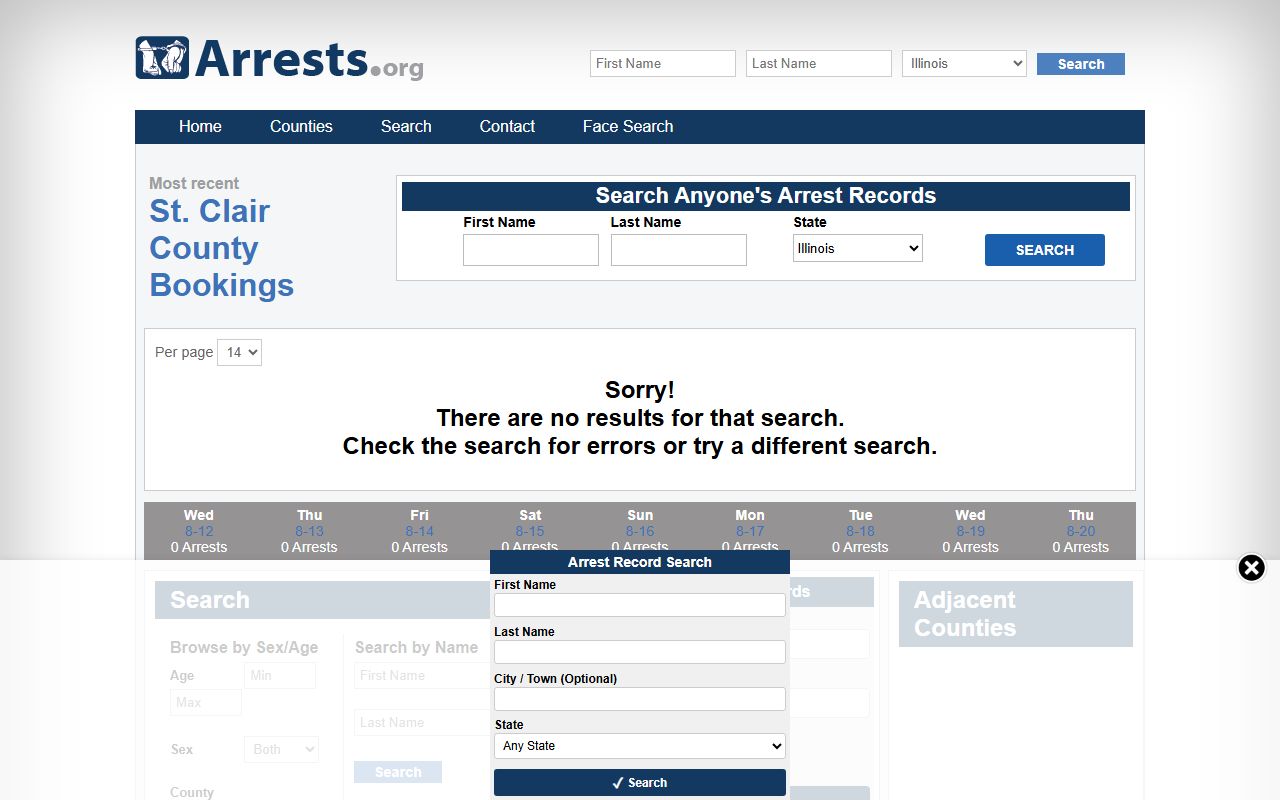
Arrests.org runs its own index of dated pages. Mugshots.com does the same. A dated page shows how that publisher lays out its material. It does not show a complete dataset. Nor is it current county data.
Multi-state networks make name collisions a real hazard. The out-of-state page below is flagged on purpose as a mismatch. Don't treat it as Illinois coverage. Don't link it that way either.
No paid removal service gets a name or a nod here. When an official outcome changes a record, start with the source agency and the court. Then try the publisher's correction channel if it has one. A private index can't change what the official record says.
St. Clair Story Timing
News in St. Clair County moves on events, not schedules. BND posts to its Crime section as stories break. Metro East Star and RiverBender publish when an incident, an agency release, or a court filing gives them a reason. Belleville's police archive comes out weekly. The Sheriff's county activity archive runs monthly. None of that matches the hourly update on the current-inmate list.
Timing gaps explain the odd results. Someone can be missing from a news page, quoted in a story, or already off the roster, all at once. Write the source date next to every lookup. Keep the reading narrow: a story tells you what an outlet reported when it ran, the roster shows who is in custody when you check, and the court file holds what happens after.
When building a records trail, save two dates separately. Log the publication date and the event date. Then set the article beside the Sheriff's current list, the monthly calls archive, and whichever city source the story names. A regional outlet may write up an East St. Louis, Belleville, O'Fallon, or Cahokia Heights incident, but the underlying report still sits with the arresting agency. That distinction keeps a FOIA request tight and stops you from mistaking one news account for a full county list.
For Belleville, O'Fallon, or Cahokia Heights stories, the city pages point to the local police records route. City arrestees who land in county detention still flow through the Sheriff roster and county FOIA process. A sentence to state custody raises a different question, answered by the Illinois Department of Corrections search rather than the county roster. Local reporting adds color. It is not a booking list.